
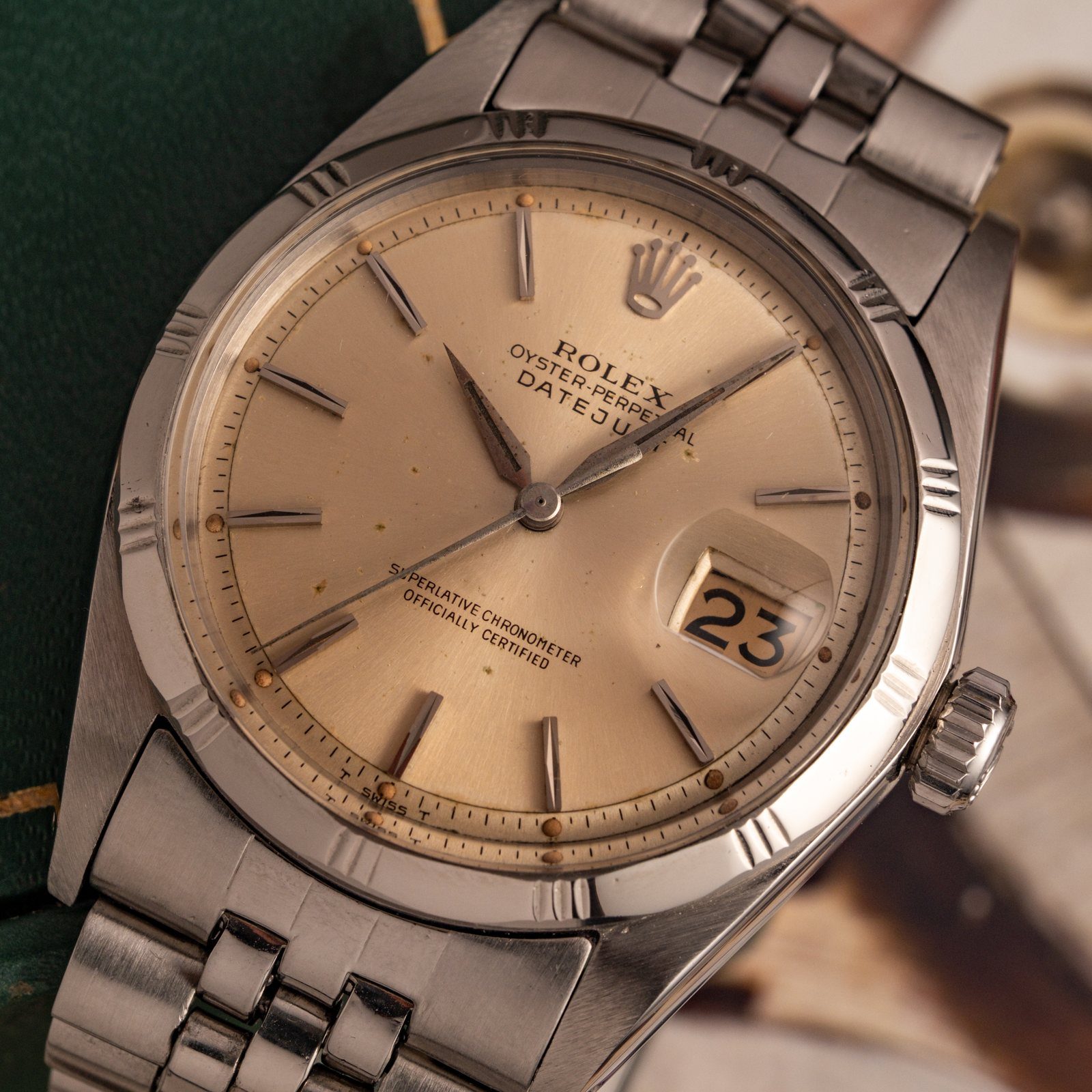
The Datejust is the watch most people picture when they hear "Rolex". It is also one of the most rewarding vintage watches to buy, because Rolex made it for so long and in so many versions. Two watches that look the same in a small photo can be 20 years apart, with different movements, crystals and dials, and very different values.
This guide explains the generations, the dial and bezel variants, and the checks we make before a Datejust goes into our shop.
1945: a date that changes itself
Rolex launched the Datejust in 1945 to mark the company's 40th anniversary. In Rolex's own words, it was the first self-winding wrist chronometer to show the date in a window on the dial. The first model, ref. 4467, came in 18-carat gold with a fluted bezel and a five-piece bracelet created especially for it. The bracelet was named after the anniversary: the Jubilee.
The Cyclops lens, the small magnifier over the date, followed in the 1950s; it first appeared on the refs. 6304 and 6305 (sources give 1953 or 1954). With that, the Datejust had every feature it still has today.
Early Datejusts (refs. 4467, 6305, 6605 and others up to the late 1950s) are rarer and more delicate, and parts are harder to find. For a watch to wear, most collectors start with the references that came next.
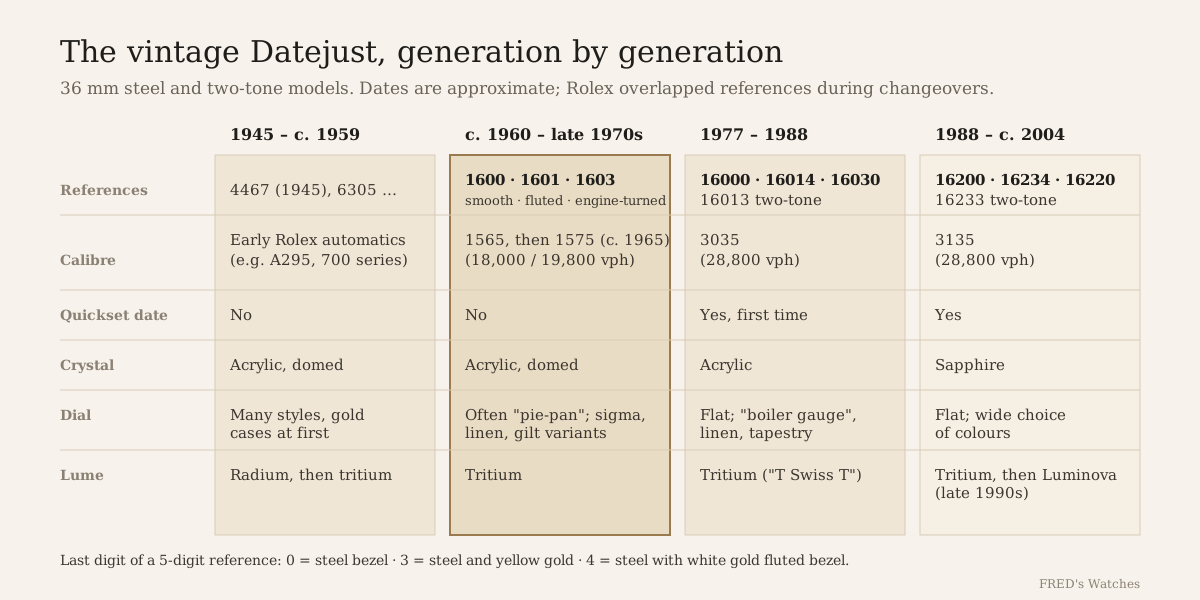
The generations at a glance
| 4-digit (c. 1960 – late 1970s) | 5-digit 160xx (1977–1988) | 162xx (1988–c. 2004) | |
|---|---|---|---|
| Steel references | 1600 smooth, 1601 fluted, 1603 engine-turned | 16000, 16014, 16030; 16013 two-tone | 16200, 16234, 16220; 16233 two-tone |
| Calibre | 1565, then 1575 from about 1965 | 3035 | 3135 |
| Beat rate | 18,000, then 19,800 vph | 28,800 vph | 28,800 vph |
| Quickset date | No | Yes | Yes |
| Crystal | Domed acrylic | Acrylic | Sapphire |
| Dial | Often "pie-pan"; later flat | Flat | Flat |
| Lume | Tritium | Tritium | Tritium, Luminova from about 1998 |
How to read a five-digit reference: the last digit tells you the bezel and metal. 0 is a steel bezel, 3 is steel with yellow gold (two-tone), 4 is steel with a white-gold fluted bezel. A 16014 is therefore a steel Datejust with a white-gold fluted bezel; a 16013 is two-tone yellow gold.
The four-digit Datejust (1600, 1601, 1603)
From about 1960 to the late 1970s, Rolex made the 36 mm steel Datejust in three main versions that differ in the bezel:
- 1600: smooth, polished steel bezel. The quietest of the three.
- 1601: fluted bezel in white gold (fluted bezels were always precious metal). The classic Datejust look, and the longest-running of the three.
- 1603: engine-turned steel bezel, with fine cuts all the way round. Sportier, and less common today than the 1601.
The "bamboo" bezel: a rare early 1603
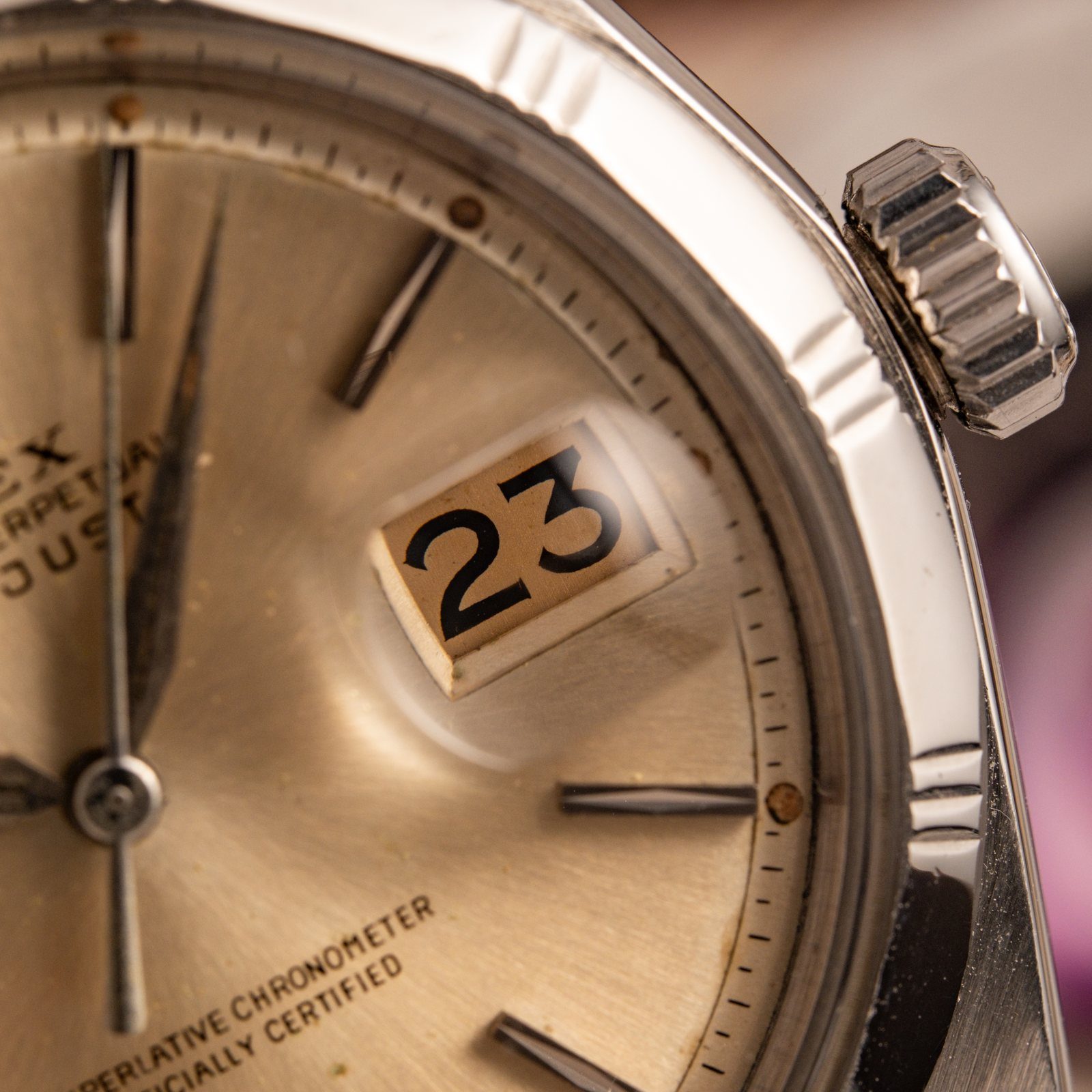
A small number of early 1603s carry a different bezel, nicknamed "bamboo". It is not engine-turned all the way round: the bezel is smooth, with raised, ridged sections at regular intervals that look like the joints of a bamboo stalk. Collector and dealer sources place it at the start of 1603 production, roughly 1959 to 1962, and note that it usually comes with silver dials and Dauphine or alpha hands. Because it was made for such a short time, a 1603 with an original bamboo bezel is one of the rarer steel Datejusts. The watch at the top of this page is one of them.
What makes the four-digit Datejust special
- The pie-pan dial. On many of these dials the outer edge slopes down like the rim of a pie tin. It gives depth and changes with the light. The change to flat dials was gradual, not a clean cut: late four-digit watches from the mid-1970s can have original flat dials, and all five-digit dials are flat. A flat dial on a late 1601 or 1603 is therefore not automatically a replacement.
- The domed acrylic crystal. Softer, warmer and more reflective than sapphire. Light scratches polish out.
- The movement. The four-digit Datejust was made over almost two decades, so the movement inside changed along the way. Early watches have calibre 1565 (18,000 vibrations per hour). From about 1965 Rolex fitted calibre 1575 (19,800 vph), and around 1972 it added a hacking seconds hand (the seconds stop when you pull the crown) without changing the calibre number. Do not be confused by the bridge: Rolex used the same engraved parts across the family, so many date movements carry "1560" or "1570" on the bridge. None of these movements has a quickset date; to change the date you turn the hands around through midnight.
- The variety. Over those years Rolex used arrow and baton markers, alpha, Dauphine and baton hands, gilt and matte dials, linen-textured dials and many colours.
Dials collectors look for
- Sigma dials (σ). In the 1970s, a group of Swiss watchmakers (through the gold-promotion association APRIOR) marked dials whose hour markers and hands were made of gold. On Rolex dials you see two small Greek sigmas on either side of "T SWISS T" at 6 o'clock. The marking was recommended, not compulsory, and was used for only a few years, which is why collectors like it.
- Linen dials. A fine woven texture, usually silver, grey or champagne. Beautiful in daylight.
- Early gilt dials with gold-coloured print on a glossy dial, from the early years of the reference.
- Early hands. Dauphine and alpha hands belong to the early years; most later watches have baton hands.
The five-digit Datejust (16000, 16014, 16030, 16013)
In 1977 Rolex introduced calibre 3035: a faster beat rate (28,800 vph, so a smoother sweep of the seconds hand) and, for the first time on the Datejust, a quickset date you can change with the crown. The dial became flat. The 160xx references kept the acrylic crystal; sapphire arrived with the 162xx references and calibre 3135 in 1988.
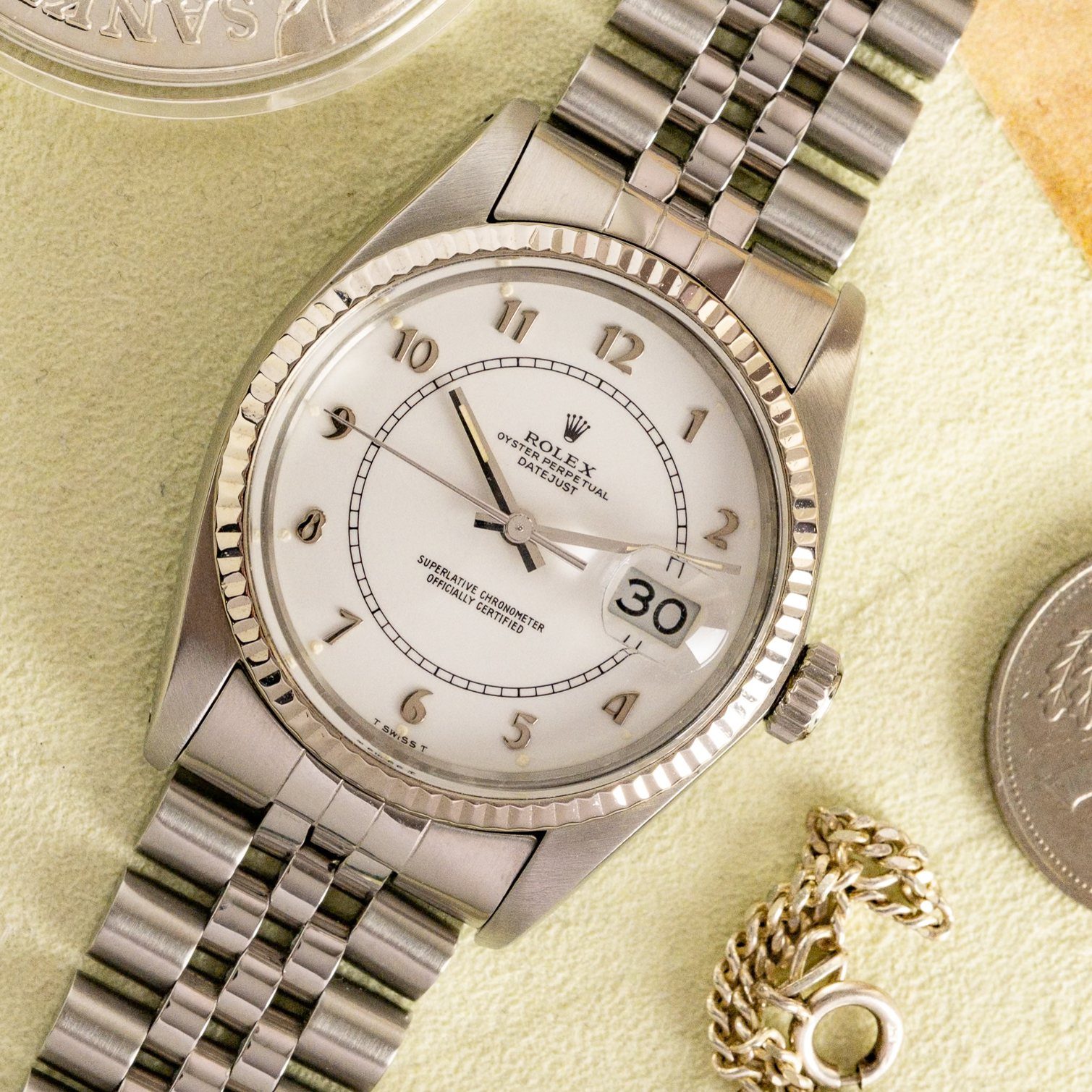
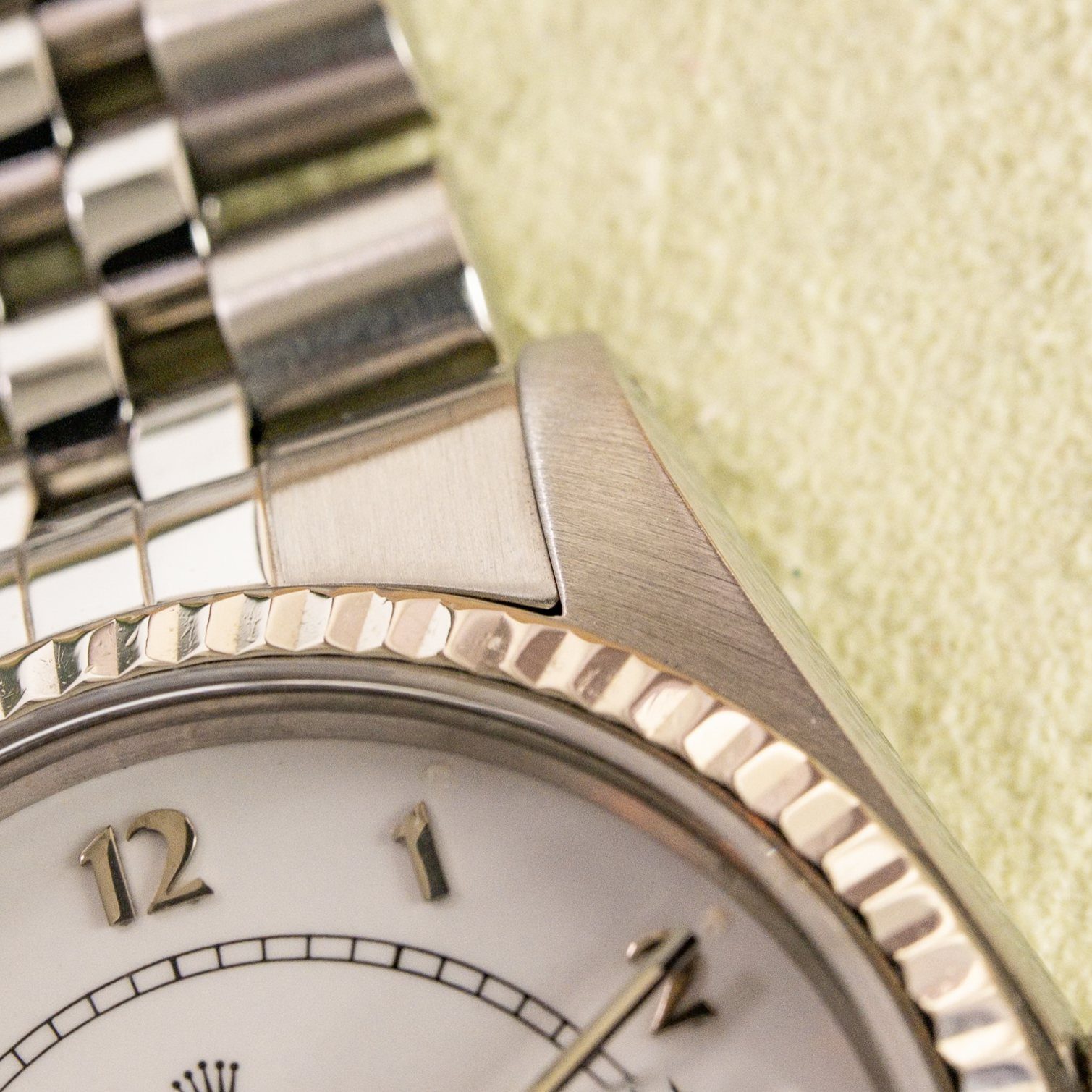
For daily wear, the 160xx is often the smart choice: easier to set and service, but still with tritium lume, a slim case and the old-style bracelet. It also has one of the most unusual dials Rolex ever put in a Datejust.
The "boiler gauge" dial
The boiler gauge dial uses stylised Arabic numerals and an inner track, so the dial looks like a steam pressure gauge. It appears in some 16014 Datejusts of the late 1970s and 1980s, in white, cream and other colours. Rolex never published production figures. Collectors on Rolex forums describe it as rare but divisive: some people love it, some prefer the classic baton dial. Forum members have reported sales of 16014s with boiler gauge dials between about US$6,000 and US$11,000, depending on condition and completeness.
The Jubilee bracelet: check the stretch
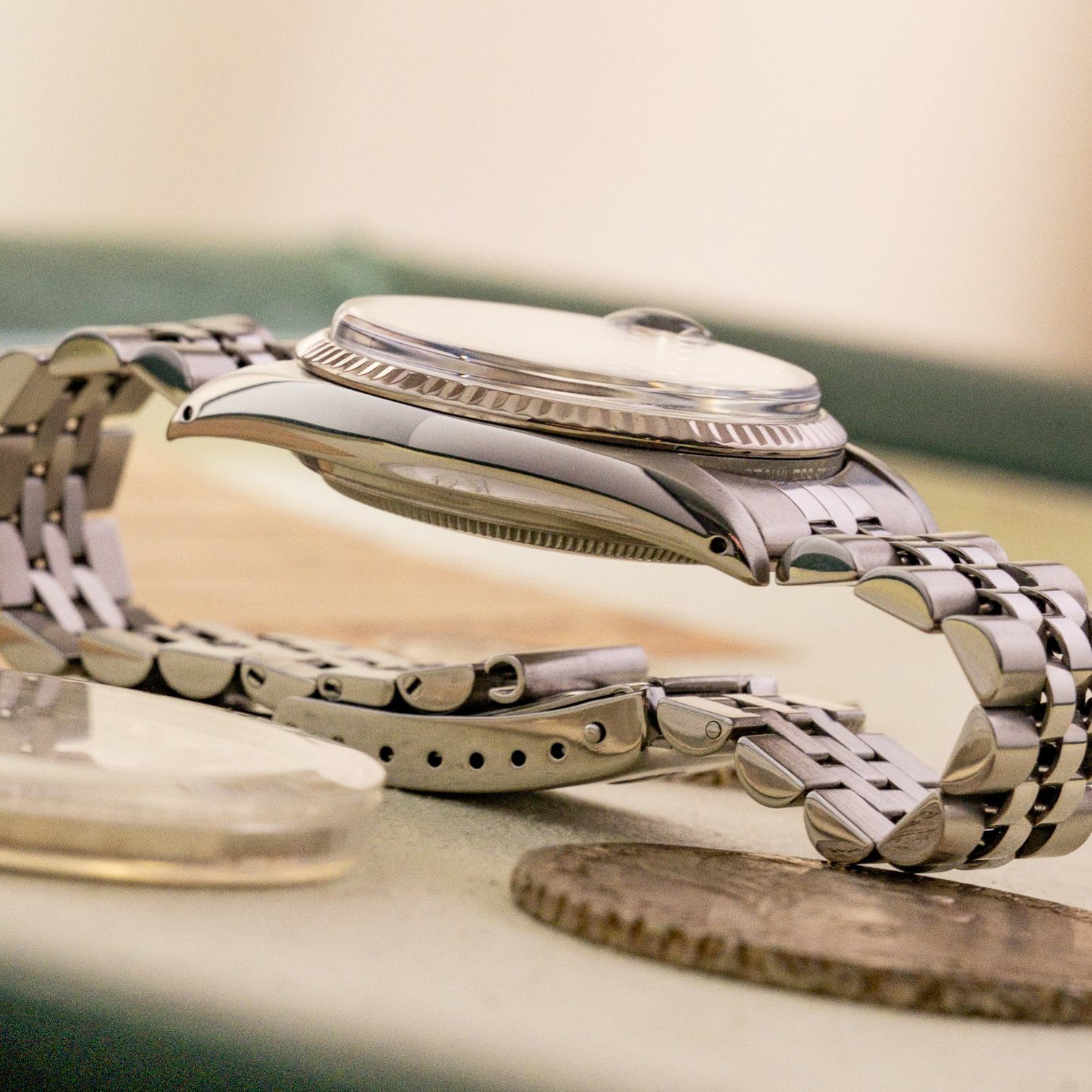
Almost every vintage Datejust comes on a Jubilee bracelet, and the bracelet is often the weak point:
- Folded links. Vintage Jubilees are made of folded (hollow) steel links; the early folded Jubilee for the Datejust carries the reference 6251H on the clasp. Rolex only moved to solid links on the Jubilee in the 2000s. Folded links are light and comfortable, but dirt collects inside them and they stretch more easily.
- Stretch. The stretch comes from wear between the pins and the holes of every link, not from bent metal. Look closely at the pins: when the holes around them have worn oval, the links sit loose and the bracelet sags. Hold the watch with the bracelet horizontal: a tired bracelet sags in a curve, a good one stays nearly straight. Be careful with photos: links can be pushed together to hide stretch. Heavy stretch can be reduced by a specialist, but it never looks new again.
- Length. Check how many links are there and the wrist size it fits. Extra original links are hard to find and expensive.
- Date codes. Rolex stamped date codes on its clasps. A clasp dated close to the watch is a good sign that watch and bracelet have been together from the start.
What we check before buying a vintage Datejust
- Dial original, not redone. Redials often show softer print, the wrong font for "Rolex", a crown logo with the wrong shape, or lume plots that do not match the hands. Rolex's own service dials are genuine parts but reduce collector value.
- Hands and lume match. On a tritium dial, the hands should have tritium of the same colour and age. Bright white Luminova hands on an aged cream dial mean the hands were replaced.
- Case unpolished or lightly polished. Look at the lugs: sharp edges and the bevel on top of them should still be visible. Heavy polishing makes the lugs thin and the edges round, and it cannot be undone.
- Serial and reference numbers. The serial is engraved between the lugs at 6 o'clock, the reference at 12 o'clock. The serial dates the case roughly and should fit the dial and movement.
- Movement. Ask about the last service and the timing result. These movements are robust, but a full service on a vintage Rolex costs several hundred euros.
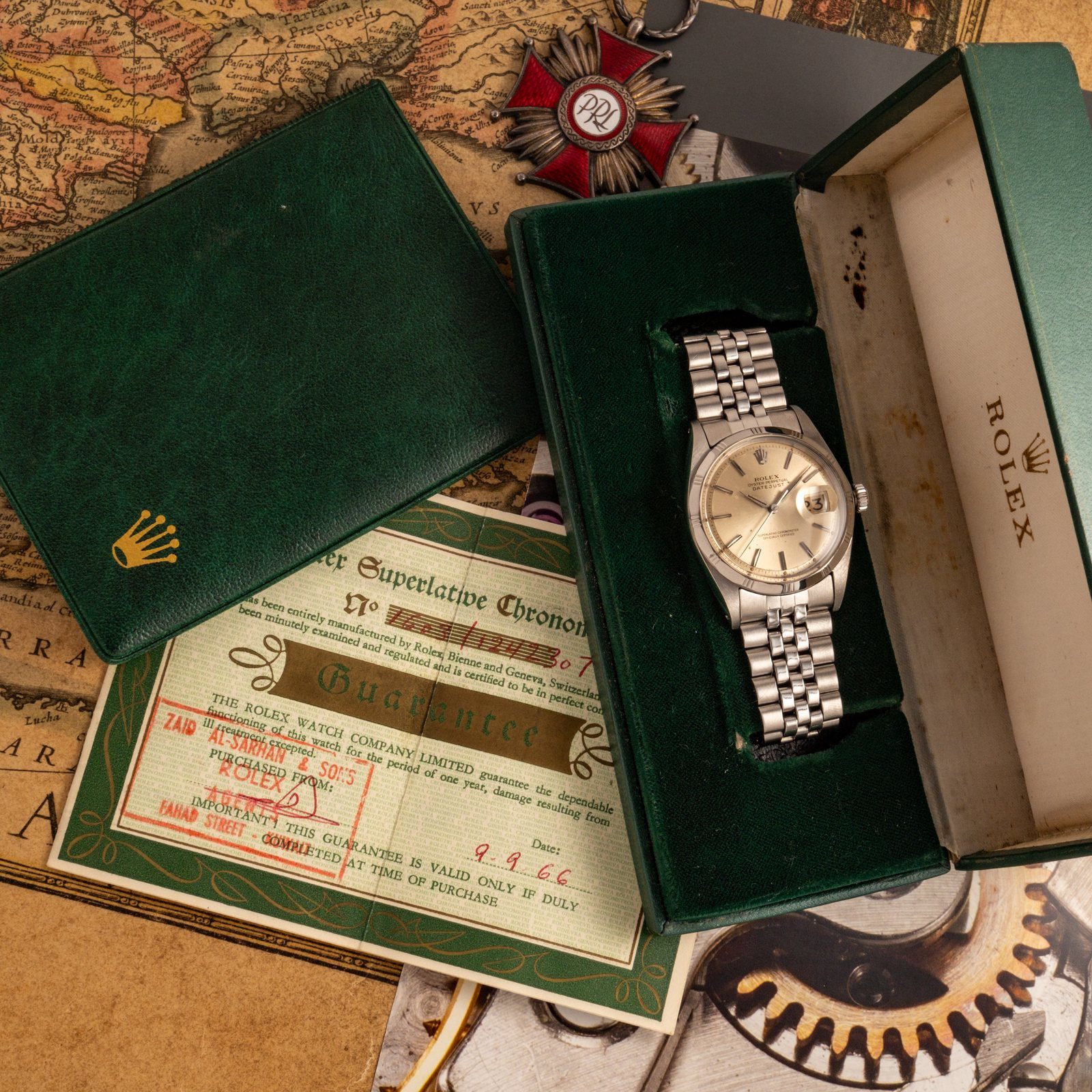
- Box and papers. Original papers add value and, more importantly, history. A full set is uncommon for a four-digit Datejust.
Prices in 2026
Price trackers give a clear picture for steel models in October 2026:
- 1601: around US$4,700 on average (WatchCharts estimate).
- 16014: around US$5,900 on average (WatchCharts estimate). Chrono24 asking prices run from roughly US$4,700 to US$7,300.
- 1603s with rare details (bamboo bezel, early hands, unpolished case, full set) and 16014s with special dials sit above these averages.
Two-tone and full-gold models follow their own market. As always, condition and originality matter more than the reference number.
1601, 1603 or 16014: which one?
- Choose a 1601 if you want the classic Datejust look with all the vintage character: domed crystal, fluted white-gold bezel, often a pie-pan dial.
- Choose a 1603 if you want something less common and slightly sportier, with the engine-turned steel bezel, or, for the collector, the rare early bamboo bezel.
- Choose a 16014 if the watch will be worn every day: quickset date, faster movement, still a proper vintage Rolex with tritium dial.
Frequently asked questions
What is the difference between the Rolex Datejust 1601 and 16014? Both are 36 mm steel Datejusts with white-gold fluted bezels. The 1601 (about 1960 to the late 1970s) has a calibre 1565 or 1575 movement without quickset and a domed acrylic crystal. The 16014 (1977–1988) has calibre 3035 with quickset date, a faster beat rate and a flat dial.
What is a Rolex 1603 "bamboo" bezel? A rare early bezel on the steel Datejust 1603, made roughly from 1959 to 1962. Instead of being engine-turned all the way round, it is smooth with raised ridged sections at intervals, like bamboo. Most 1603s have the standard engine-turned bezel.
Which movement is in a Rolex Datejust 1603? It depends on the year. Early 1603s have calibre 1565; from about 1965 calibre 1575; from about 1972 the 1575 gained hacking seconds. The bridge is often engraved "1560" or "1570" because Rolex shared parts across the family.
When did the Datejust get a sapphire crystal? With the 162xx references and calibre 3135 from 1988. The 160xx references (1977–1988), such as the 16014, have acrylic crystals.
What does a sigma (σ) on a Rolex dial mean? That the hour markers and hands are made of gold. The two sigmas next to "T SWISS T" were used on some 1970s dials.
Is a vintage Datejust a good investment? Steel Datejusts have held their value well and are easy to resell. Rare dials, unpolished cases and full sets have done best. Buy one because you want to wear it; the value is a bonus.
Vintage Datejusts at FRED's Watches
In our shop now: the Datejust ref. 1603 with the bamboo bezel, a full set, and the Datejust ref. 16014 with the rare boiler gauge dial. Every price includes insured express shipping.
Sources and further reading
- Rolex, History 1926–1945 (rolex.com): Datejust launch and Jubilee bracelet
- Monochrome Watches, The History of the Rolex Datejust (references, calibres 1565/1575, hacking 1972, Cyclops on 6304/6305, acrylic until the 160xx, sapphire with the 16234)
- Bob's Watches, Rolex movements explained and Rolex sigma dial definition
- Fratello, Buying Guide: Finding The Right Vintage Rolex Datejust For You and New Collectors Beware (bracelet stretch, service costs, polishing)
- BeckerTime, Quick comparison guide: Datejust 1600, 1601, 1603, 16000, 16014, 16030 and Rolex's rarest bezels (bamboo bezel)
- Phillips lot notes on sigma dials
- WatchCharts price estimates for the 1601 and 16014 (October 2026); Chrono24 listings for the 16014
- Rolex Forums, How rare is the boiler gauge Datejust?
- OmegaForums thread on buying a vintage Jubilee bracelet (hidden stretch)
- Fratello, Legendary vintage bracelets: the Rolex Jubilee, and Bob's Watches, Ultimate guide to Rolex bracelets (6251H folded Jubilee)
Image credits: all watch photos FRED's Watches. Diagram: FRED's Watches.